Starting a Chapter or Community
How to launch an Applied AI Society chapter in your city or on your campus. An AAS chapter is not a generic AI meetup. It is a local community of people who have been Jarvised, operate their own Personal Agentic OS daily, trade notes with other people doing the same, and are actively spreading the practice outward into their friends, teams, and companies. Shared vocabulary. Shared practice. Shared on-ramp. Shared mission to Jarvis the people around them.
The path into hosting one is specific: get Jarvised first (do the Supersuit Up workshop), then come back to this playbook. If your city has not hosted a workshop yet, that is the entry path for you specifically: see Chapter Planting below.
The short version: every city's applied AI scene has an anchor (a person, or small group, who has decided to hold the thread) and what they cultivate is a community of practice (a living, people-centered organism of applied AI practitioners sharing field notes and making each other better). This playbook is how you become that person in your city.
What a Chapter Looks Like on the Ground
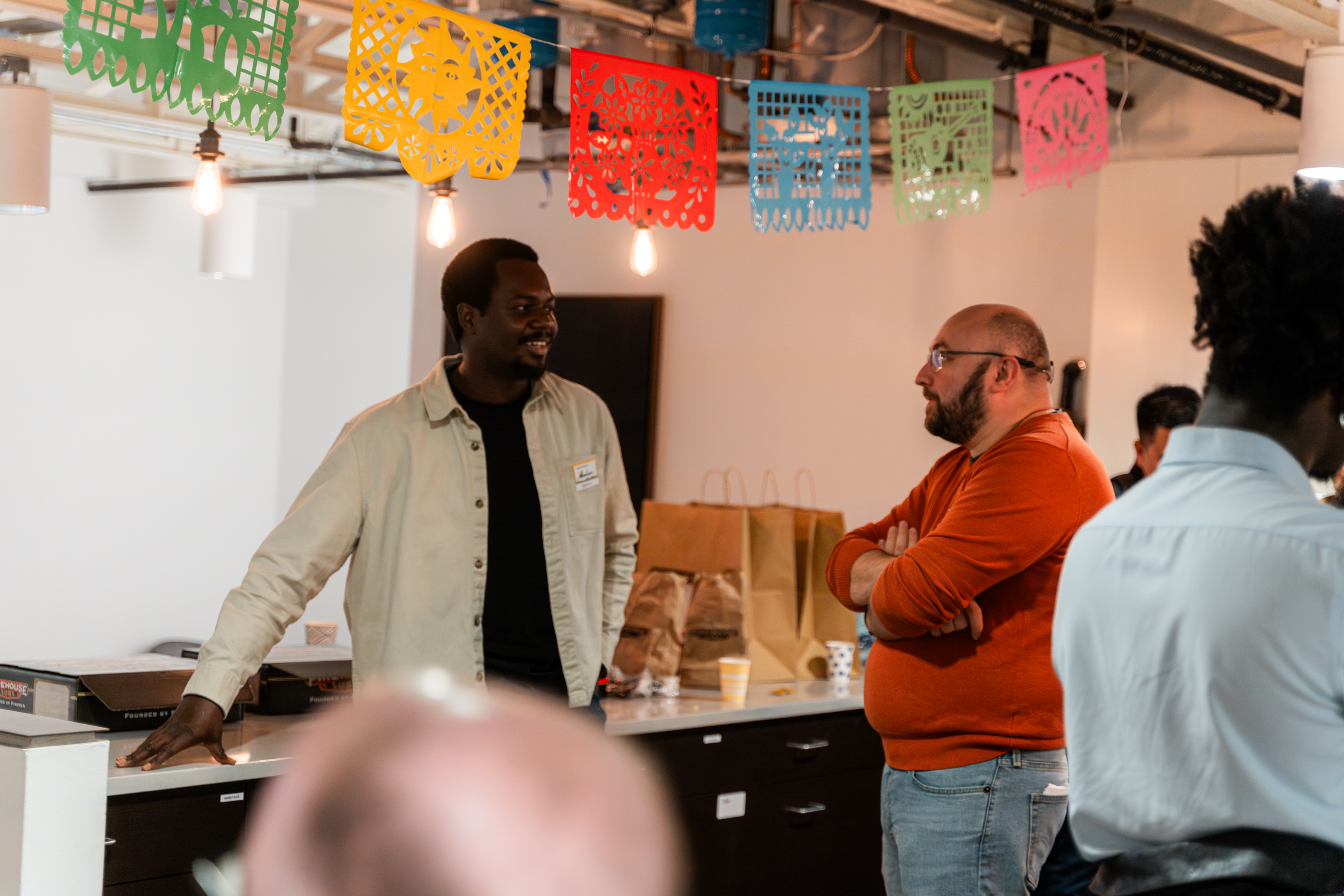
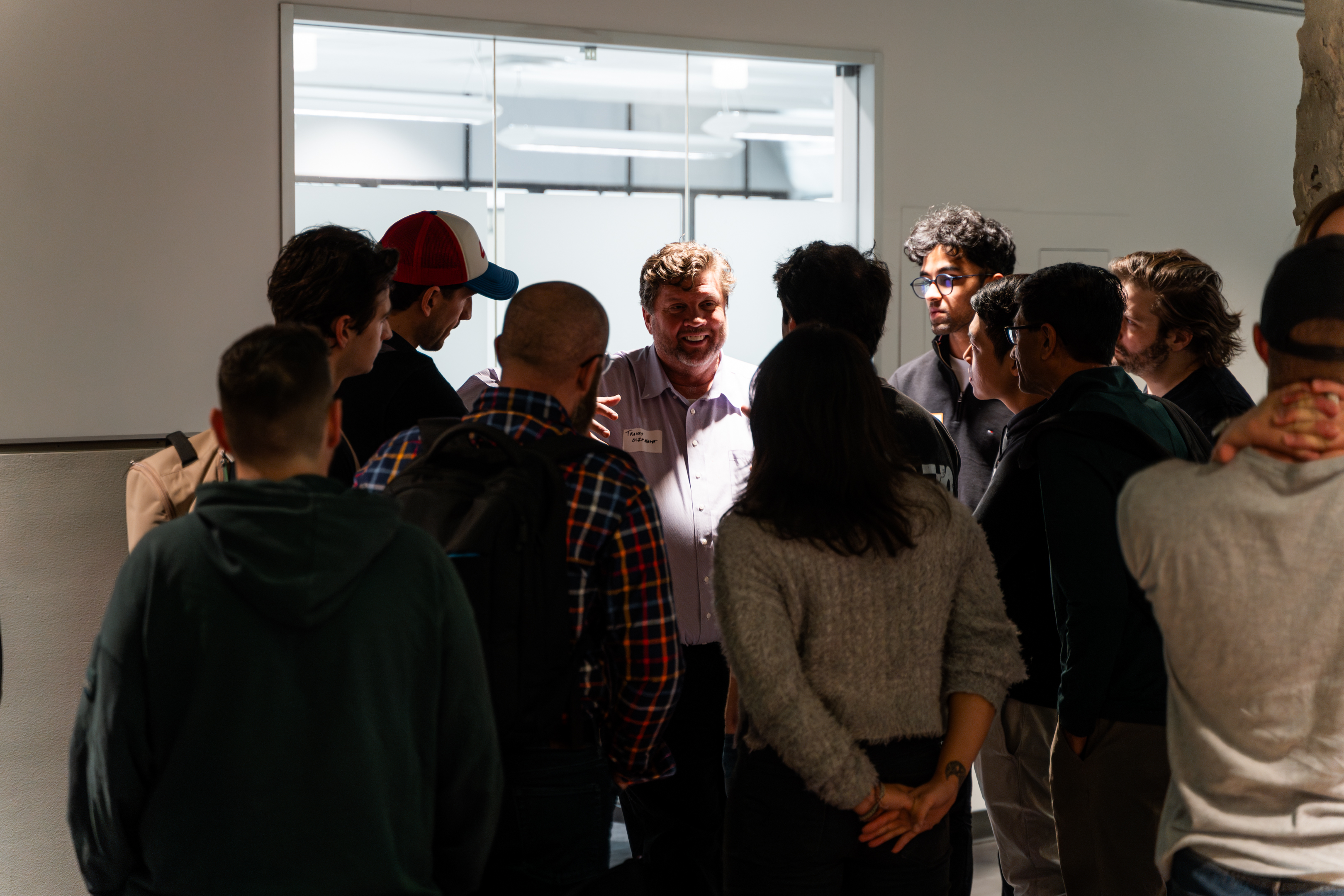
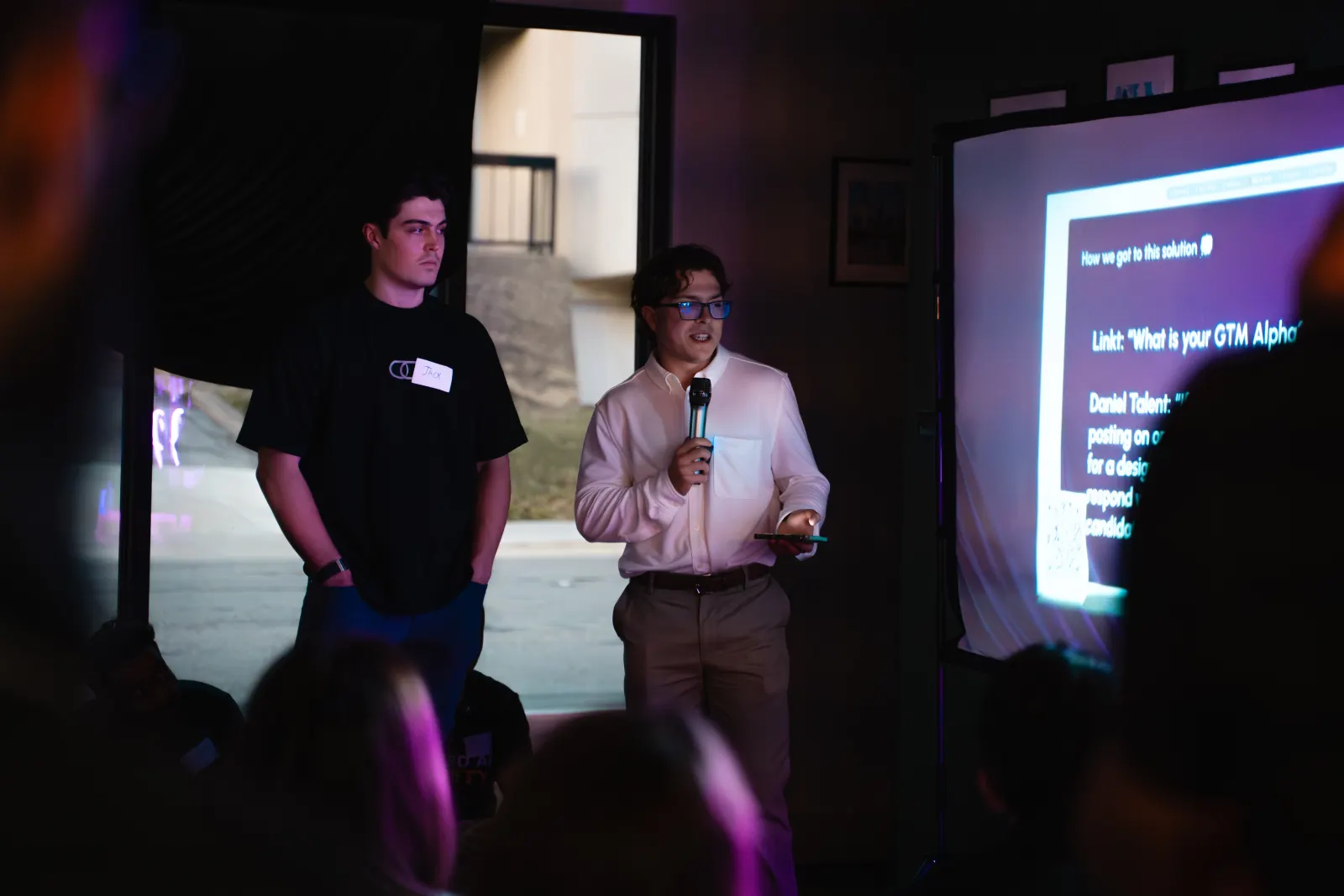
Real rooms, real people, in Austin. This is the bar: warm, practical, full of real work getting done together.
What Makes an AAS Chapter Different
AAS chapters are differentiated from generic AI meetups by three things:
- Shared practice. Every person in the room is walking (or building toward) a daily applied AI discipline. The conversations are field notes from people actually operating a Personal Agentic OS, not consumer-AI hot takes.
- Shared vocabulary. Personal Agentic OS, context lake, harness, hyperagent, Jarvis, activation. These are not jargon. They are the common tongue that lets conversations actually compound week to week.
- Shared on-ramp. Every chapter is downstream of the Supersuit Up workshop. Members arrive already literate. Leaders arrive with a working Personal Agentic OS on their own laptop. The workshop is the gravitational center of the chapter, not a side program.
- Shared mission to spread it. Members are not just Jarvising themselves. They are Jarvising their friends, their collaborators, their teams, and eventually their whole companies. The chapter is the context where that outward spread compounds. Personal practice is the floor; the ceiling is a city, a company, or a community where everyone is operating their own Personal Agentic OS.
- Shared discipline of 80/20 thinking. Members do not chase every tool launch. They are trained to ask, on every problem: what are the twenty percent of moves that unlock eighty percent of the leverage here? Applied AI at its highest and best use. Not tool tourism. Not toy demos. Practical, effective, impactful deployment of AI against real work.
If an "AI community" in your city is a show-and-tell about consumer AI apps and prompt tricks, that is not what an AAS chapter is. An AAS chapter is a room full of people compounding their own hyperagency together, sharing what is actually working, and spreading the practice outward into their friends, teams, and companies.
Why Local Communities Exist
Applied AI Society exists to make the world applied AI literate. Local communities are where that actually happens.
There is a massive gap between what AI can do and what organizations are actually doing with it. That gap is full of opportunity. But most people cannot see those opportunities from where they sit. They need someone in their community who can show them.
That someone might be you.
A chapter can take many forms. It could be a formal Applied AI Society chapter. It could be a student group within your university's existing AI club. It could be three friends who host their first workshop and see who shows up. The format matters less than the outcome: people in your community learning applied AI by doing it.
If your campus already has an AI club, you do not need to start a new one. Hook in. Wear the shirt. Use the playbooks. Host an Applied AI event within the club you already have. We will support you with resources, small budgets, and a connection to the national network.
The model is subsidiarity: national provides the source material, brand, and network. You provide the energy, the people, and the local context.
Beyond Campus: Libraries, Schools, and Community Organizations
Some of the most impactful applied AI literacy work is happening outside college campuses. College students who already understand applied AI are going into their local communities and teaching others: elementary schoolers, high schoolers, library patrons, boys & girls clubs, workforce development programs.
Libraries are a particularly powerful channel. They adopt programs more rapidly than universities (no bureaucracy, no curriculum committees, no semester timelines), they serve diverse populations, and they are trusted community institutions.
If you are a college student who already gets this, consider: who in your community needs applied AI literacy the most? It might not be your classmates. It might be the people in your hometown, your local library, your old high school, or communities abroad that you have a connection to.
We are building the best open-source applied AI literacy source material in the world. You can use it to teach anyone, anywhere. The playbooks on this site will help you run programs. And we want to profile and amplify the people who are already doing this work, so their example inspires others.
Where Chapters Are Emerging
Austin is the genesis chapter. Others are active or taking shape in Dallas (via AITX Community), Houston, San Antonio, Chicago, LA, NYC, and Bordeaux, plus student chapters on select campuses. Some are full AAS chapters; others are partnerships with existing AI communities where we contribute Supersuit Up workshops and playbooks as the chapter scales.
If your city is not on the map yet, that is often the best reason to start something. We are looking for the person who decides to be the anchor of their scene.
Chapter Planting
Many cities do not yet have an active AAS chapter because nobody has been Jarvised there yet. That is not a dead end. It is the specific on-ramp we built for you.
If you want to host a chapter and your city has not had a Supersuit Up workshop, the move is: request one. AAS will evaluate bringing the workshop to your city (in person when we can, remote when we cannot) to plant the seed. That first workshop is how a chapter begins. We call this chapter planting.
The chapter-planting path:
- Request a workshop. Reach out via the AAS Discord. Tell us where you are, who you know locally, and what energy exists in your city right now.
- Help assemble the first room. If AAS comes out (or hosts remotely for your city), you recruit the first participants: fifteen to thirty people who want to get Jarvised together. They are your future chapter.
- Get Jarvised yourself. You go through the workshop with the group. You walk out with a working Personal Agentic OS on your laptop, built around your actual goals. Now you have the context to lead.
- Host your first chapter event. Within a month of the planted workshop, you run your first chapter meetup. The Jarvised group is your starting core. They are already practitioners. You are trading notes together, not introducing concepts from zero.
This pattern is how chapters actually scale. Workshops plant. Chapters grow from what the workshop planted.
You're a Good Fit to Start a Chapter If...
- You've been Jarvised, and you want to Jarvis others. Being Jarvised yourself is the floor. Chapter leaders go further: they want to Jarvis their friends, their collaborators, their teams, and eventually their whole business or company. Everyone around them ends up operating their own Personal Agentic OS. If your ambition stops at your own laptop, you are a daily applied AI practitioner, which is great. A chapter leader is a practitioner who is specifically trying to multiply the practice outward. You have completed the Supersuit Up workshop and are already thinking in terms of who you want to bring into this next. If your city has not had a workshop yet, that is the Chapter Planting path above, not a skip-the-workshop path.
- You think in 80/20. Practical, effective, impactful AI use at its highest and best use. You are always asking, on every problem: what are the twenty percent of moves that unlock eighty percent of the leverage here? Chapter leaders model that discipline for the room. Tool tourism, toy demos, and prompt-trick show-and-tells are not the vibe.
- You're an industry operator first. The strongest chapter leaders are entrepreneurs in a real industry (real estate, hospitality, healthcare, creative production, manufacturing, services, anything) who are using applied AI to solve a real problem in that domain. The chapter is downstream of the operating work. People can sense the difference between a chapter led by someone in the arena and one led by an AI educator with no skin in any industry. The first one carries weight.
- You're entrepreneurial. You see building an applied AI network as completely in your self interest. You want to be at the center of your city's applied AI economy, not waiting for someone to hand you the opportunity.
- You're a connector. You don't need to be the most technical person in the room. You need to be the person who gets the right people into the room.
- You can mobilize. Given two weeks' notice, you can get 50-75 people to show up. You already have a network, or you know how to build one fast.
- You recognize the implementation gap. You see organizations around you that know they should be using AI but have no idea how. That frustrates you.
- You're high agency, low ego. You'll figure things out without waiting to be told what to do. You'll give credit to others and focus on the community, not your personal brand.
- You're in the right life stage. Late college, just graduated, or early career. Or you're someone who mentors people in that window and wants to build alongside them.
This Probably Isn't for You If...
- You haven't been Jarvised yet. That is not a permanent block. Go get Jarvised at a Supersuit Up workshop first. If your city has not hosted one, see Chapter Planting. Come back once you are operating your own Personal Agentic OS.
- You're looking for a paid position from day one. Chapter leaders earn through the network they build, not a salary from national.
- You want a detailed instruction manual for every decision. We provide playbooks and support, but you're running your chapter. Ownership is the point.
- You want to consume, not contribute. Applied AI Society is for people who build, share, and connect. If you're looking to passively attend events without putting anything back into the community, this isn't the right fit.
- You don't actually want to be in the applied AI space yourself. Chapter leaders are applied AI practitioners first, organizers second.
- Your only relationship to AI is teaching about it. We need chapter leaders with operating exposure to a real industry, where they are using applied AI to do real work and can speak from inside the arena. Course-only operators can do excellent work in adjacent formats, and the chapter leader role specifically is built for industry operators.
Know Your City's Scene
Before you start a chapter, take a hard look at what already exists in your city. Every city has a different AI landscape, and your chapter needs to fit that landscape, not copy-paste what works somewhere else.
We think about this as an ideal scene profile: treating cities themselves as distinct profiles with their own strengths, gaps, and cultures.
Questions to ask:
- How many AI communities already exist here? If your city is already saturated with AI meetups, clubs, and events, your chapter needs a sharper angle. If there's almost nothing, you have wide open space but less existing momentum to tap into.
- What's the talent mix? Is your city heavy on research and academia (universities, labs) or on applied, commercial work (agencies, startups, enterprises)? The gap between “people who know AI” and “people who get paid to apply AI” varies by city. Your programming should address your city's specific gap.
- How does community work here? In some cities, one group text gets 50 people to show up. In others, it takes weeks of outreach to fill a room. Understanding your city's community culture tells you how much effort to budget for mobilization.
- Are there customers nearby? Chapters thrive when there are local businesses who will pay for applied AI work. If most of your city's talent has to look elsewhere for clients, the practitioner pipeline is harder to build.
- Who's already doing this work? Find the other community leaders, meetup organizers, and ecosystem builders in your city. If you can't name them, you need to spend more time learning the landscape before launching. A chapter leader who doesn't know the other players in their city is a red flag.
The principle: We are most impactful when we connect to where people already gather. If your city has an AI club, a startup accelerator, or existing tech communities, build on those. If there is a gap and no connective tissue for applied AI work, build something new. Either way, the goal is literacy at scale, not new infrastructure for its own sake.
Your community does not have to look like Austin's. It should look like your city, run by someone who understands what your city needs.
What National Provides
Founders who open doors. Applied AI Society was founded with Travis Oliphant (creator of NumPy, SciPy, cofounder of Anaconda) as founding advisor. That credibility helps when you're reaching out to sponsors, speakers, and university partners. You're not building a random club. You're building a chapter of something real, backed by people with track records.
Playbooks. Everything we've learned from the Austin genesis chapter is documented publicly. Event formats, checklists, partnership guides, content distribution workflows, CRM setup, outreach automation. You don't start from scratch.
Brand assets. Logo, design system, templates. You stay on-brand while making it your own locally. There's no shortage of things to fork and take inspiration from.
Light sponsorship for early events. We'll help cover the first couple of events to remove the financial barrier. Campus events with a room, AV, and volunteers are genuinely cheap. The goal is to get you to the point where local sponsors take over.
The network. You're not building alone. You plug into a national (and soon global) community of chapter leaders, practitioners, and sponsors. What works in Austin, Bordeaux, or LA gets shared with you immediately.
Mentorship. Reach out via the AAS Discord whenever. Early on, you can do a weekly call if you want. The communication cadence will evolve as we figure out what works, but you won't be left on your own.
Brand infrastructure. A Remotion repo with ready-to-use compositions for event flyers, promo videos, and visual assets. Clone it, swap your chapter's details (speaker names, dates, venue, co-host logos), and render. The compositions handle brand consistency for you. If you're not technical, you can also use the brand guidelines to create assets with Canva, Gamma, or whatever you prefer.
Discord. The public community Discord for all chapter leaders, practitioners, and members to compare notes, share opportunities, and co-work across cities. This is the single public community space. Beyond Discord, you're encouraged to create your own invite-only group chat for your local chapter (Signal, iMessage, Telegram, GroupMe, whatever works for your people). AAS also runs a small number of invite-only rooms for specific cohorts (student leaders, business owners, builders). If one fits you, post in the AAS Discord and we will route you in. These smaller spaces should feel special. People earn their way in by showing up and doing real work.
What's Expected of You
Run events. The core of any community is regular events. Start with monthly. Every event is an activation into the applied AI economy. The concept: you are giving your audience a landscape map. Practitioners who are actually making money in applied AI share their field notes. The audience leaves knowing what the paths are, what is real, and what is hype. These events can happen through your own chapter, through an existing AI club, through a coworking space, or through a university department. The venue and structure are flexible. The through-line is always the same. Formats can vary (see the full catalog).
Add AAS national as a manager on every event. Whether you use Luma, Meetup, or both, add the national AAS account as a co-host or manager on every event page. This gives national access to the attendee list and lets us build a shared email list across all chapters. A strong national list benefits every chapter: it lets us promote your events to members in nearby cities, send national updates, and build the overall community.
Collect LinkedIn and GitHub on registration. When setting up your event registration, include fields for LinkedIn profile URL and GitHub username (optional but encouraged). This data flows into the national CRM and helps us understand who's in the community: what they build, where they work, what skills they have. That enrichment makes the whole network more valuable. When a business owner in Austin needs a practitioner with a specific background, or a chapter leader in LA wants to find local speakers, the CRM is how we connect the dots.
Find your local patron. Every chapter needs a local champion: a business owner, executive, or organization that believes in what you're building and wants to support it. This isn't a cold sponsorship pitch. It's finding someone who sees the value of a local applied AI talent network and wants to say “I planted this chapter.” This usually happens naturally after your first couple of events prove the model.
Create stickiness. The north star metric for a new chapter is retention: 20 or more people who keep coming back across your first three events because the events are genuinely that valuable. If people come once and don't return, something needs to change. If they keep showing up, everything else (sponsors, growth, opportunities) follows.
Share what you learn. Write event recaps. Document what worked and what didn't. The whole system gets better when chapters feed insights back to the network.
Stay on brand. You have freedom in how you run your chapter. The required protocols for communicating with national are still being defined, but the principle is simple: use whatever tools let you flow and get things done as a local organizer, and keep us in the loop on how it's going.
The Opportunity
This is worth saying plainly: building a chapter puts you at the center of your city's applied AI economy. Every practitioner, every business owner, every sponsor who cares about applied AI in your area will flow through your events.
The network you build is yours. The relationships, the reputation, the deal flow, the career flow, the knowledge flow. We call it enlightened self interest: you're building something that serves your community and your career at the same time.
Frame this correctly: chapter leadership is a business accelerator that compounds on top of the work you are already building. Your industry, your operation, your career stay the main event. The chapter gets layered on top, and the right to be accelerated is earned by serving the local community first. The rooms, introductions, deal flow, and warm intros follow because you served. The accelerator is a byproduct of the service.
Chapter leaders don't just organize events. They become the person everyone calls when they need applied AI talent, when they have a project to staff, when they want to understand what's possible. That's a powerful position to hold, and it compounds over time.
The people who figure out applied AI now, while the gap is wide open, will be the ones everyone else calls in two years.
How to Get Started
- Get Jarvised. Do the Supersuit Up workshop. If your city has not hosted one yet, follow the Chapter Planting path to request one. The workshop is the floor everything else builds on, not an optional add-on.
- Read the docs. Start with What is the Applied AI Society? and the Applied AI Canon. If the philosophy resonates, keep going.
- Read the playbooks. Browse the chapter leader playbooks to see what running a chapter actually looks like.
- Reach out. Post in the AAS Discord. You can also get in touch here.
- Have a conversation. We'll talk about your city, your network, what format makes sense, and what support you need.
- Run your first event. We'll help you get the first one off the ground. From there, you're building.
See Also
- Anchor of a Scene -- why the person who decides to hold the thread is the bottleneck, not the city's demographics
- Community of Practice -- what you are actually building and how to keep it healthy
- Applied AI Live -- one proven event format for practitioner-driven demos
- Building Partnerships -- finding sponsors and venue partners
- Hosting an Event -- the soft skills of being the host