What is the Applied AI Society?
The Core Idea
The Applied AI Society is a 501(c)(3) nonprofit empowering leaders to apply the world's most advanced AI technologies responsibly to strengthen their businesses, communities, and humanity's collective future.
Advanced means the frontier, not the baseline. Everyone has ChatGPT in a browser tab. The Society exists for leaders who want to operate at the edge of what's possible: Personal Agentic OS, harness engineering, context engineering, agent orchestration. The work that separates level-one users from hyperagents. This work has a name: applied AI. It is the deliberate, human-led deployment of AI in service of what a person or organization is actually trying to build, commercial or otherwise.
Responsibly means accountable at every scale:
- Business. Real prosperity, real capability, real ownership of the tools and work that generate it.
- Community. Local businesses, neighborhoods, chapters. The applied AI economy should lift the places that host it.
- Humanity. Applied AI literacy as a public good. Public interest, not just platform interest.
- Planet. The physical footprint of AI (data centers, energy, ecological impact) held to the same standard of accountability as any other infrastructure we depend on.
If that's you, this is for you.
We do this through three initial core offerings:
- Jarvis workshops. The concrete, hands-on path. Our flagship Supersuit Up workshop walks you through building your own Personal Agentic OS: an AI system that knows who you are, what you are building, and how you think, and gets smarter every day you use it. See the full Workshops catalog for the current lineup.
- This public documentation site. docs.appliedaisociety.org is the base layer of trustworthy AI and applied AI literacy for humanity. A living, source-controlled, continuously-updated field guide written by practitioners actually doing the work. Free. Open. No gatekeeping.
- Local community chapters. Hyperlocal spaces in cities and on campuses where applied AI gets practiced together. Led by trained community leaders. Austin is home base; active chapters and nodes in Bordeaux, LA, Dallas, and growing. Chapters run Applied AI Live events, Supersuit Up workshops, office hours, and hackathons. See chapter leader playbooks if you want to start one.
The limiting reagent in this transition is not compute or capital. It is applied AI literacy, and most people lack it. Most don't even know what's possible.
What We Actually Do
Three pillars, one mission.
Pillar 1: Help people get their Jarvis
The Supersuit Up Workshop. Our flagship in-person workshop. Roughly 3.5 to 4 hours, hands-on, instructor-led. You walk out with a working Personal Agentic OS on your laptop, built around your real goals, projects, and decisions. We run these in Austin (our home base), our chapter cities (Bordeaux, LA, Dallas and growing), and on demand for partner communities, universities, and companies. The full playbook is open source and you can try it yourself, though most people struggle to finish without a trained practitioner next to them to debug the edge cases.
The Agentic OS Trainer pipeline. We train student leaders and practitioners to deliver Supersuit Up workshops in their own communities. This is how the work scales (not through us, through you). Chapter leaders and trained practitioners go on to Jarvis local business owners, peers, and university cohorts. Some of them turn it into a career.
Pillar 2: Build the base layer of applied AI literacy for humanity
docs.appliedaisociety.org is the public knowledge repo. We treat this site as a public good: the base layer of trustworthy, source-controlled, continuously-updated documentation for applied AI literacy for humanity. Not a marketing site. A living field guide written by practitioners actually doing the work.
The deeper gap this closes is not implementation help. It is that people don't know what's possible. The Mayor of Austin put it perfectly: “You say AI to people and their knee-jerk is 'we're gonna have more data centers.' They don't know what the application is.” Not understanding applied AI is the new “I don't know how to read.”
Applied AI literacy is the activation bar for applied AI as a discipline. Literacy is the first rung and the one AAS can commit to earthshotting for humanity. Practice is the daily discipline on the other side of that bar. Mastery is the horizon, developed only through daily applied AI discipline, measured against real goals, built in community, and expressed in service to humanity. Fluency, the ability to have good conversations about applied AI, lives inside the practice as a milestone you pass somewhere along the way. All three rungs matter.
The repo is organized around what people need to understand and do:
- Concepts naming the frameworks practitioners use right now (context lakes, harness engineering, hyperagency, and dozens more)
- Roles documenting the careers emerging in the applied AI economy
- Playbooks for practitioners, business owners, chapter leaders, students, and presenters
- Case studies showing what the work actually looks like in the field
- Philosophy for the deeper commitments behind how we build
- Standards like INTEGRATE.md and ALIGN.md that anyone can adopt
All of it is open source. Chapter leaders and university partners use it as source material for their own derivative courses. Nothing is gatekept. That is how education scales without becoming propaganda, and how we fulfill our mandate to make trustworthy applied AI literacy accessible to humanity.
Pillar 3: Run local community chapters
AI fluency and mastery are built in community. You can read every doc and watch every tutorial and still not become fluent. Real fluency comes from practicing the work next to other people who are doing it, debugging each other's setups, and sharing what's actually landing with clients or classmates this week. Chapters are the place that happens.
Chapters are hyperlocal communities in cities and on campuses where people learn applied AI together. Led by trained community leaders. Austin is home base. Active chapters and nodes in Bordeaux, LA, Dallas, and growing. The format is deliberately flexible: sometimes it's a formal chapter, sometimes a student group inside an existing AI club, sometimes three people deciding to host their first event. The outcome matters more than the shape: people in a room, learning applied AI by doing it together.
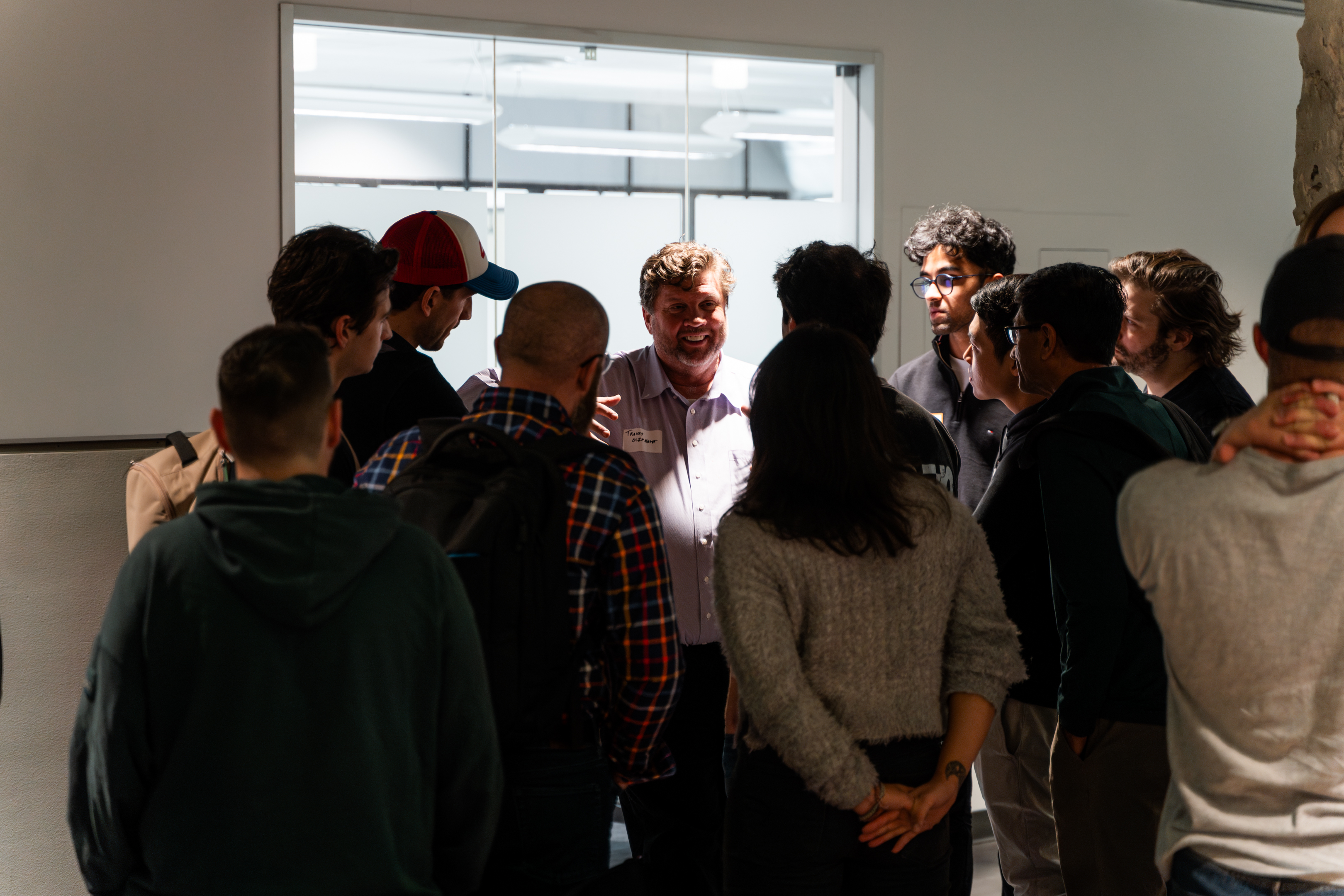
Every AAS event is an activation into the applied AI economy. Our flagship format Applied AI Live brings live players together: practitioners actually doing the work, excited to share field notes from the front lines. We also run Applied AI Office Hours (business owners get hands-on help from practitioners), community Supersuit Up workshops, and hackathons. See all event formats →
Chapter leaders get real support. Playbooks, event formats, brand assets, small event budgets, and a direct connection to the national network. Leading a chapter is training for the emerging Community Leader role. If you want to start one, see the chapter leader playbooks.
Every pillar feeds the others. Chapters host workshops and make the docs real in local contexts. Workshops turn attendees into practitioners who lead chapters. The docs give both a foundation to stand on.
The Moment We're In
AGI is effectively here for anyone who knows how to wield it. A single person with the right system can do what used to require a team of ten. The bottleneck is no longer the technology. It is the human.
This is creating a split. Some people are compounding their capabilities faster than at any point in history. Others are watching their skills erode in real time. We call the people going up hyperagents: humans who have wrapped themselves in AI systems that amplify their unique capabilities, judgment, and vision. The economy is diverging into hyperagents and everyone else.
AAS exists to help as many people as possible experience hyperagency. The tools are accessible. The knowledge is available. What most people lack is the path: the literacy, the community, and the practical guidance to suit up. That is what we build.
New roles are emerging as quickly as old ones are shrinking: AI implementation specialists, automation architects, agent developers, fractional AI executives. Companies across every industry are desperate for people who can actually do applied AI at a serious level. These are six-figure roles that barely existed two years ago. We're documenting them as they form: see the full list →
One thing worth saying plainly: if the only AI you use is ChatGPT in a browser tab, you are operating at level one. That is the floor, not the ceiling. The chat is not the product. The order-of-magnitude difference shows up when you have your own Jarvis that knows your context, your files, and your voice, and operates from that knowledge every time you interact with it. That is the crossing we help you make.
The labor-market consequences of this shift are already measurable.
Stanford's Digital Economy Lab found that in AI-exposed occupations, employment for workers 22 to 25 is growing 16% slower than in less-exposed occupations.
The entry ramp into traditional knowledge work is quietly closing. What replaces it is a different shape of career, with a different set of skills at the top: strategic thinking, social capital, tacit knowledge, taste, and community leadership. We wrote up the implications in RIP To The Career Ladder.
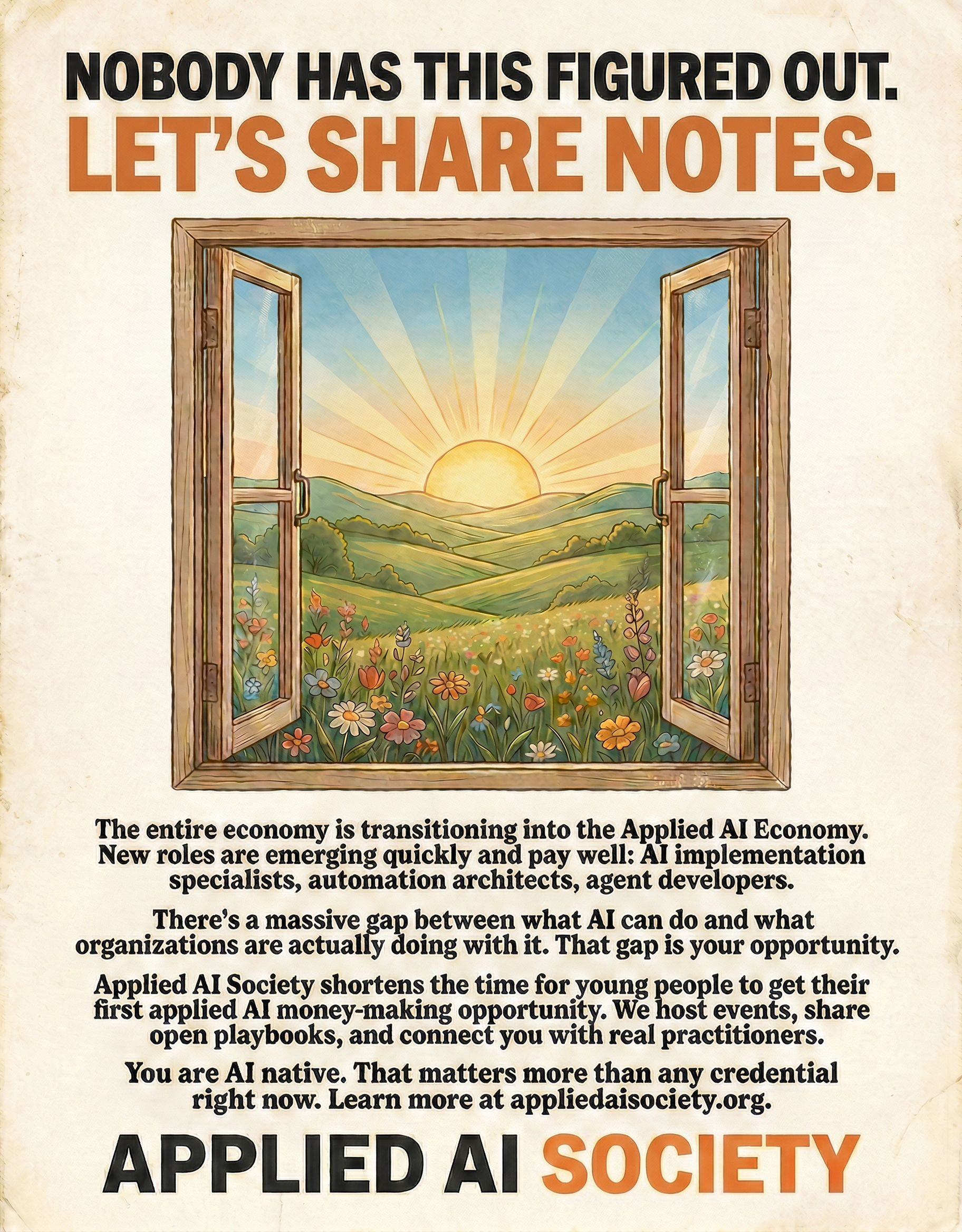
Nobody has this figured out. So let's all agree nobody has this figured out, and let's share notes.
For the full picture of the urgency and what applied AI actually means, read The Writing on the Wall, an Applied AI Society leadership essay on what applied AI actually means.
What We Are
The Applied AI Society is a 501(c)(3) nonprofit empowering leaders to apply the world's most advanced AI technologies responsibly to strengthen their businesses, communities, and humanity's collective future. The people we train go on to prosper themselves, lift their communities, serve the public interest, and hold the physical infrastructure of AI to account.
Who We Serve
Our audiences are wide and growing: founders and operators trying to reclaim strategic time, business owners drowning in open threads, consultants and practitioners building an applied AI discipline, creatives who want their tools to multiply their output, and college-aged students preparing to enter a workforce that is shifting under their feet. Students are a key leverage point (many go on to Jarvis others in their communities as part of the career path we're building), and they are one audience among several.
We call the people who bridge the gap between AI capability and real-world implementation “applied AI practitioners.” They help organizations actually use AI to better serve their customers and communities. That's the career path we're building together.
What We Believe
At the heart of everything we do is a simple idea: AI should free people to do more meaningful work, not replace them. And the people it frees should own their tools, their data, and their future.
Some work is irreplaceably human: presence, judgment, taste, care, responsibility. Some work is necessary but doesn't carry that weight. Thinking machines exist to carry the second kind so humans can spend more time on the first.
That's the Applied AI Canon. Efficiency is not the goal. More human-only work is.
Why Sovereignty Matters
There is a deeper layer to this mission that goes beyond jobs and literacy.
The biggest AI companies are building platforms designed to capture your data, your workflows, and your dependency. The lock-in is coming. It is not a conspiracy. It is the structural incentive of every VC-backed hyperscaler: subsidize adoption, build dependency, monetize the captive audience. They start with the model, then build the harness, then capture your workflows and integrations. Each step up the stack owns more of your operations. Every major hyperscaler (OpenAI, Anthropic, Google, Microsoft) is converging on the same goal: owning your entire business. Not just your work life. Your code, your documents, your email, your calendar, your strategic thinking, your customer data, your workflows, your integrations. All flowing through their systems, all creating dependency that compounds until switching is unthinkable.
We believe people should own their own intelligence. Not rent it. Not subscribe to it. Own it. That means owning your context lake (the knowledge base that makes your AI useful), owning your harness (the system wrapped around the model), and keeping everything in portable, platform-independent files that you can take anywhere.
That said, we are pragmatists. The best available tool right now is often proprietary. We recommend Claude Code as our default harness in the Supersuit Up Workshop. We use frontier models from Anthropic and OpenAI in our own workflows. The difference is that we build on portable foundations: plain markdown files on your computer, open formats, systems designed so you can switch providers any time you need to. Sovereignty is not about refusing to use proprietary tools today. It is about never being trapped by them tomorrow.
We are training builders who understand sovereignty at every layer of the digital stack and can help others achieve it.
Open source models are getting better every quarter. Open harnesses are maturing. The sovereign alternative is being built right now, piece by piece, by builders who believe people deserve to own their future. If we build it to be as easy and effective as the proprietary platforms, it is just a matter of time.
Anyone who wants a sovereign future should be part of this movement. We are training the builders of that future.
How It Works
The three pillars above are what we offer. This section covers how the operation actually runs underneath them.
Field notes, not textbooks. The site you're reading right now is a living field guide, not a static curriculum. In a field that changes weekly, textbooks are outdated before they reach the reader. Social media rewards hype over accuracy. We need a different model: field notes written by practitioners who are actually doing the work, source-controlled and continuously updated, honest about what we don't know yet.
Roles document the careers emerging. Concepts name the frameworks practitioners are using right now: context lakes, harness engineering, and many others. Case studies show what the work actually looks like. Playbooks capture how to run events, find clients, and build chapters. None of this is finished. All of it is evolving.
One public community, many invite-only spaces. Our Discord is the single public community space where anyone can join, ask questions, share what they're working on, and connect across chapters. Beyond that, chapter leaders and practitioner groups run their own invite-only group chats (Signal, iMessage, Telegram, whatever works locally). These smaller spaces feel special because they are. You earn your way in by showing up, doing real work, and adding value. The public Discord is the front door. The invite-only chats are the living rooms.
Sponsors, not gatekeepers. Local businesses and AI companies sponsor chapters because they want access to AI-native talent. Sponsors fund the community. They don't control it.
Agent File Standards
As AI agents become the primary way people interact with codebases, organizations, and each other, we need shared conventions for how agents find and understand information. AAS identifies emerging patterns in the agent tooling ecosystem and publishes lightweight specs so the community can build on shared foundations.
INTEGRATE.md is a file format for teaching agents how to wire a library into an existing codebase. Instead of reading human-oriented docs and guessing, the agent reads INTEGRATE.md and executes the integration steps directly. Read the spec →
ALIGN.md is a file format for agent-readable alignment evaluation. Someone pastes your ALIGN.md into their agent and says “evaluate whether we should work together.” The agent reads both parties' files and returns an honest assessment of fit. The goal: truncate the time between meeting someone and knowing what the first pilot project is. Read the spec →
If you're considering working with us, check our ALIGN.md. If you publish your own, send it along and we can run bilateral evaluation before anyone takes a call.
For Students and Emerging Practitioners
You already use AI every day. You prompt, you iterate, you build things your professors haven't seen yet. That's real fluency. The problem is there's no clear path from “I use AI” to “I get paid to apply AI.”
Applied AI Society shortens that path.
You'll meet practitioners who are making money in applied AI right now. You'll hear exactly how they got their first opportunities. The paths are more varied than you think: workflow automation, AI consulting, building AI-native products, intrapreneurship inside existing companies, agent development, freelance engineering. See the full landscape →
You'll build a portfolio of applied work and connect with organizations that need exactly what you know how to do.
Don't think of yourself as “I don't know anything.” You're AI-native. You can pick things up. You're flexible. That matters more than any credential right now. We're here to help you turn that fluency into your first opportunity.
For Universities and Young Adult Organizations
Your students and young members are anxious about AI and their careers. They're right to be. The job market is shifting under their feet, and traditional curricula can't keep up with weekly model releases.
Applied AI Society gives young people a community where they can channel that anxiety into action. Our events draw participants from across departments and backgrounds (not just CS) because applied AI is cross-disciplinary. Business students, design students, liberal arts students all bring perspectives that make implementations better.
Bringing Applied AI Society to your campus does not require starting a new club from scratch. If you already have an AI club, we can support it with playbooks, shirts, small event budgets, and a connection to the national network. If you do not have one, we can help you start something lightweight. The barrier to entry is low. We provide the playbooks, the event formats, and the community infrastructure.
Want to bring Applied AI Society to your university or organization? Get in touch →, or explore a university partnership →.
Get Involved
- Get Jarvised: Read the Supersuit Up workshop → or see upcoming workshops and events →
- Subscribe to the newsletter: Applied AI Society on Substack →. Biweekly field notes on what's happening in the applied AI economy.
- Start or join a community: Learn how →
- Present at an event: Presenter playbook →
- Read the docs: Browse playbooks, standards, case studies, and philosophy →
- Join the community: Join our Discord → to connect with practitioners and chapter leaders across cities. Follow @AppliedAISoc on X for updates.