Gary Sheng: Running My Entire Life With a Personal Jarvis
How I use my Personal Agentic OS to run seven life pillars, compound strategy, and reclaim the one resource that actually matters: judgment.
I have been running a version of a Personal Agentic OS for about 14 months. Before that I spent roughly two years using ChatGPT-level tools. I mention this only to say: when I talk about how much leverage a real Jarvis gives you, I am not speculating. I have lived the difference, and the evolution to get here happened in distinct phases.
This is my field testimony as a superpower user of my own Jarvis. It is also an invitation. If you are reading this and have not crossed from chat-window AI to a real Personal Agentic OS, the rest of this page is what is available to you on the other side.
The Timeline: How I Got Here
Phase 1 (November 2022 to December 2024): Two years inside ChatGPT
Intensive use of ChatGPT and ChatGPT Projects. Copy, paste, prompt, iterate, close tab. Everything lived inside the chat window. I got good at prompting. I did not have a compounding system. Every session started close to zero.
Phase 2 (January 2025): "Files are all that matter"
The unlock was simple: files are the base layer. Not the chat window. Not the model. The files.
I switched to Cursor as my harness (before I had the word 'harness' to describe what I was doing). I used it intensively with Opus and whatever the best available model was, and I started building out what would become my Personal Agentic OS: relationship dossiers, meeting notes, strategic documents, a persistent body of text that any AI could read and act on. This is when my leverage started to compound instead of reset every session. This is the real start of my Jarvis.
A few months in, I went viral on X with a single observation: "The Cursor for Writing is Cursor." The IDE coders used was secretly the best writing tool ever built, because every word you write becomes searchable context and past ideas strengthen new writing. Writers were wasting time in isolated apps, notes disconnected from drafts, ideas trapped in silos. The best writing environment was never built for writers. It was sitting in their developer friend's tab.
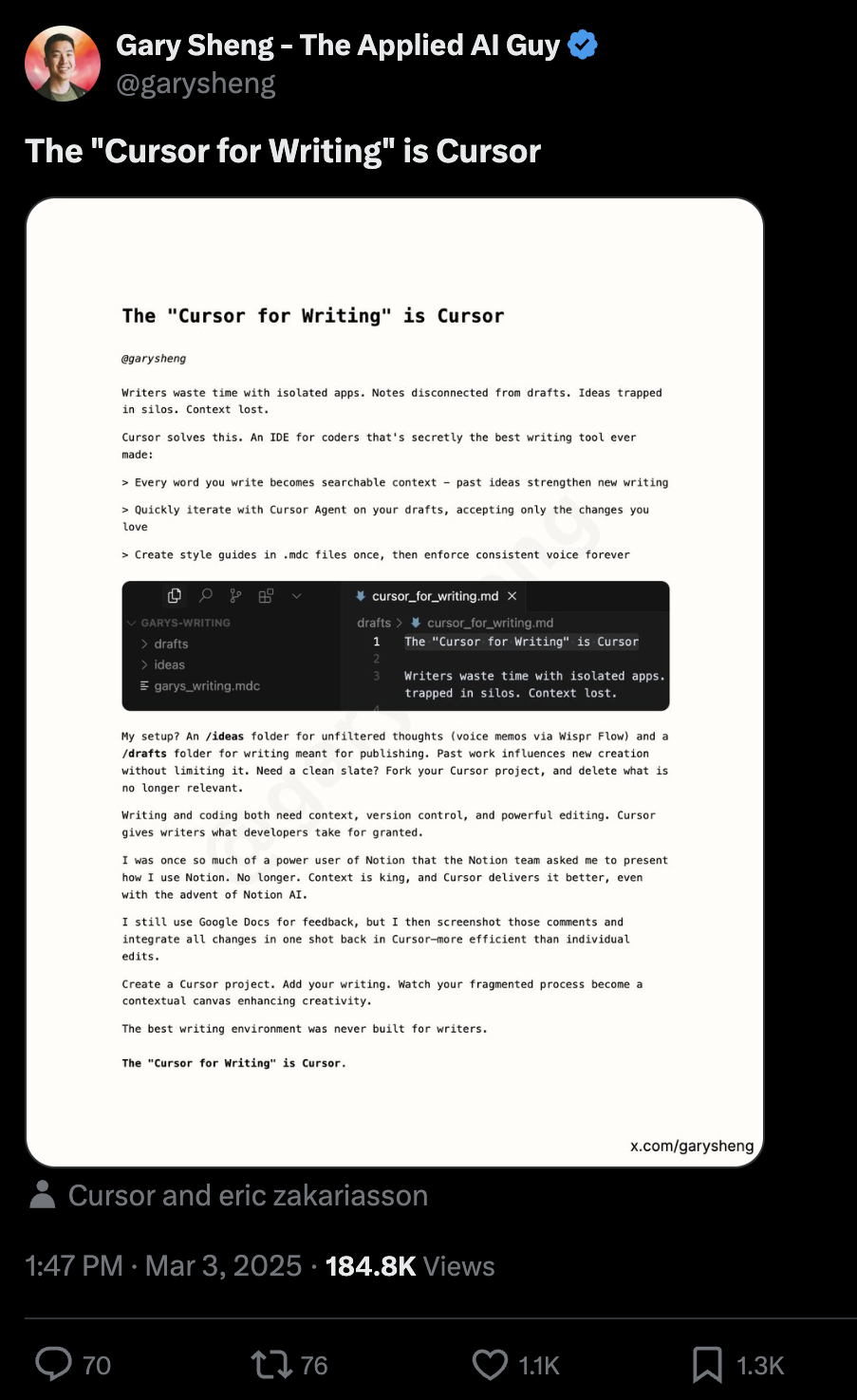
March 3, 2025. 184K+ views. The tweet landed because the insight generalizes: the tool matters less than whether it treats your own files as first-class. That is the DNA of everything I have built since.
Phase 3 (November 2025): Claude Code becomes the harness
A lot of practitioners felt an inflection point in November 2025. Claude Code shipped, and the harness jumped a generation. It was just better than anything I had ever used, and it has continued to pull ahead of open-source alternatives. I have been on it intensively ever since.
One thing I stay deliberate about: I do not want to depend on Anthropic. The good news is I do not. My files have nothing to do with Anthropic. The harness happens to be theirs right now because it is the best available. The moment an open-source harness closes the gap, I take my files and walk. That is what sovereignty looks like in practice: use the best tool today, stay portable for tomorrow. See The Sovereignty Stack and The Lock-In Is Coming for why this matters.
Phase 4 (mid-January to mid-March 2026): The OpenClaw cron-job experiment
I spent a couple of months running OpenClaw with my Anthropic subscription. The pitch I bought into: automated daily plans, background agents running while I slept, cron jobs executing on my behalf. Then Anthropic banned OpenClaw, which forced me to reckon with a question I had been avoiding.
I was barely using it.
The realities of my life and the opportunities that came up, often within the same day, required more nuance than any cron job could handle. My actual days were not executing a plan. They were responding to reality with judgment. Most cron jobs, I realized, are not actually that useful for a human running a complex life. The hype around background-agent systems has cooled for the same reason. The limitations on how you can actually use a tool like OpenClaw inside a real business are real.
This experiment taught me the lesson the rest of this document is built around.
Phase 5 (late March 2026 to now): Jarvising others, the mission clicks
80% of the value of a Personal Agentic OS comes from one thing: strategy.
Strategy is the new execution. Say it again: strategy is the new execution. The quality of your life is directly downstream of the quality of your decisions, and every decision runs through your life strategy. That means the highest-leverage thing you can do with AI is not automation. It is having the best possible strategic thinking partner in the room with you, all day, every day, deeply aware of your operational reality.
Cron jobs are a micro-optimization on top of that. Strategy is the base layer. Get the base layer right, and the rest compounds.
Starting in late March 2026, I began running the Supersuit Up workshop for real people. Artists, founders, operators. Watching someone get their first Personal Agentic OS stood up, watching them use AI as a co-strategist (not just an executor), watching tears flow in LA when people felt their sovereignty and capacity grow in real time. That is when the mission clicked. This is what I am supposed to be spending my time on. Jarvising people is the single most leveraged thing I can do right now, and I plan to be an advocate for it for the foreseeable future.
On the corporate side, what Ramp did with Glass is the same thesis at scale: give every employee a Personal Agentic OS, put real files in, let AI be both strategist and executor. That is the applied AI economy emerging in real time.
My Seven Pillars
Everything in my Jarvis is organized around seven active pillars of my life:
- The nonprofit I founded (Applied AI Society)
- Client consulting work
- A creative studio I co-founded
- Personal life (admin, travel, health, logistics, relationships)
- Sidequests (passion projects, favors for my network)
- Churches (pro-bono work for the faith communities I love)
- Continuous learning (staying sharp on AI/ML fundamentals)
My Jarvis knows all seven. It knows how they stack-rank against each other when they compete for time. It knows which ones are load-bearing for my mission and which are discretionary. It knows my values, my principles, my long-term goals, and my current season. When I ask for advice on where to spend the next hour, or whether to say yes to a request, it is not answering in a vacuum. It is answering in the context of my actual life.
That context is the whole point. Every hour I invest in making my Jarvis know me better compounds into every future decision it helps me make.
The Core Loop: Brain Dump → Interview → Artifact
Here is the workflow that powers almost every strategic document I produce, including this one.
Step 1: I brain dump. I hit record on voice-to-text and talk for 10 to 20 minutes about whatever is on my mind for the document I need. No editing. No structure. Just everything in my head, raw.
Step 2: My Jarvis interviews me. I tell it the brain dump is the baseline and ask it to interrogate my thinking. Poke holes. Ask the follow-ups. Make me defend the weak parts. Force me to clarify what I actually mean.
Step 3: It drafts the artifact. Armed with the brain dump, the interview, and all the operational context it already has about me, it produces the strategic document. Proposal, memo, strategy doc, brand brief, fundraising plan, whatever.
The artifact is almost always better than anything I would have written alone in the same time. Not because the AI is smarter than me. Because the combination of my judgment, my context, and its ability to pressure-test on demand is a fundamentally different mode of thinking than I can do in my own head.
This is what externalizing your brain actually feels like in practice.
Running Multiple Sessions in Parallel
Once the single-session loop is second nature, the next unlock is realizing you can run many of them at once. On a typical work block I have three to five harness sessions open simultaneously, each focused on its own workstream. A snapshot from a recent afternoon:
- One session fixing a bug for a consulting client
- One processing the last few days of meeting transcripts into my context lake
- One drafting wiki posts in the background
- One strategizing marketing copy for the online courses I am launching
I float between them. While one is reading files or running tests, I am dictating context into another. The cognitive load is lower than it sounds because each session is bounded by its own topic and its own files. I am not multitasking inside one head. I am orchestrating multiple highly-contextualized agents, each operating in its own corner of my world.
For anyone just starting: do not begin here. Open one chat. Get the hang of the basic brain dump → interview → artifact loop on a single project first. Once that cycle feels easy, you will naturally open a second window "just to try one more thing" while the first is still running. That moment is when you cross into parallel mode. Trying to start in parallel is overwhelming. Earning your way there feels obvious.
What I Actually Use It For
A partial list of the work my Jarvis and I do together on a typical week.
Strategizing major initiatives
When I am running a complex workstream (say, an invite-only gathering for a specific high-stakes purpose), the Jarvis helps me think through the strategy layer end to end. What is the actual goal of the event. Who belongs in the room. What sensitivities exist between specific guests. Which introductions would be high-leverage and which would be noise. How the invite sequencing should work. What the night-of program needs to accomplish. I do not do this once and move on. I do it iteratively, as new information comes in from conversations with co-producers and partners.
The key artifact for this kind of work is the dossier. For every high-stakes person related to the initiative, my Jarvis maintains a file with their background, interests, prior interactions, and notes on how to engage. When I am figuring out invite logic or seating or follow-up, I am not starting from scratch. I am reading my own compiled intelligence on the people involved.
Building and maintaining wikis
I use my Jarvis constantly to build out wikis for different bodies of knowledge I am curating. Public ones include my personal wiki and my faith journey wiki (FaithWalk). I also maintain several private wikis for teams and projects I work on that do not live on the public web.
The workflow is always the same. I brain dump for 10 to 20 minutes into a voice note. I hand the transcript to my Jarvis. It produces a structurally sound first draft that is properly categorized and cross-linked to what I have already written. That first pass gets me about 80% of the way there. I own the last 20%: taste, nuance, the specific phrasing that only I would use, the final ordering, the hard edits. That last 20% is where my voice actually lives.
This document you are reading is an example. The transcript from my brain dump was the substrate. My Jarvis drafted the structure. I have iterated on it across several passes and will keep iterating as things evolve. The output is infinitely better than anything I would have written alone in the same time budget, and more importantly, it exists. Things that previously would have sat in my head for months now ship within a day.
Brand and communications work
I am running a rebrand of Applied AI Society right now. The value of the Jarvis here is streamlining the conversation between me and my brand agency. Designers ask questions. I talk to my computer. My Jarvis pulls from existing context about what AAS is, what we believe, and how we communicate, then weaves in new brain dumps I add, and produces a brief the designers can actually work from. What used to be a week of back-and-forth email becomes a one-day loop.
Processing every meeting I have
This is the one I would not give up under any circumstance.
Every conversation I have that gets transcribed ends up in my Jarvis's context lake. I use Granola for meeting notes and have automations that route transcripts into my system automatically. The effect is that my Jarvis is always running on a nearly-real-time picture of my operational reality. The people I am talking to. The threads I am pulling on. The decisions being made in meetings.
This matters because I am never producing strategy that is divorced from what is actually happening in my life. If I ask for a recommendation on Monday, it can see the conversation I had on Friday that might change the calculation. The closer your Jarvis's model of your life is to your actual life, the better every output it produces becomes.
This ambient ingestion is the easiest way to continually update your Jarvis on operational reality. Set up Granola → contact lake once, and it passively compounds every day. See the capture, process, compound loop for the underlying pattern.
Events and creative output
I have skill files for recurring work. One of them is aas-init-event. I tell my Jarvis "new event," it interviews me about the purpose, audience, and logistics, scaffolds the event folder, writes the description from templates and past events, spins up the Remotion server, and renders the poster. What used to take me an hour of clicking around different tools now takes about five minutes.
I have similar skills for creating slide decks, drafting social posts in my voice, updating public wiki docs, and a dozen other recurring workflows. Every skill file I write pays compound interest. Once the flow is refined, I can repeat it across events with different audiences or venues and the marginal cost is near zero. See instruction files for the underlying concept.
Verbal re-prioritization when I am overwhelmed
When I am stuck, scattered, or about to do the wrong thing with the next hour, I talk to my Jarvis out loud. It already knows my seven pillars, how they stack-rank, what my current week looks like, and what I said I was trying to accomplish. It reprioritizes with me, calmly, using context I would have to spend 20 minutes reloading into a chat window otherwise.
Accountability and values-aligned decisions
My Jarvis holds me accountable to what I said I cared about. It knows I am only trying to do things that are high-leverage for helping people thrive in applied AI. It knows I want to support faith leaders and the churches I am associated with. It knows the personal milestones I am praying toward this year. It knows my principles.
When I ask for advice, it is filtering through all of that. The advice that comes back is the advice a wise friend who knows me really well would give. That is not an accident. I built the context for that on purpose, over many months, one brain dump and relationship file at a time.
The lesson: the more context you give your Jarvis on yourself, your priorities, and what you value, the better its advice on what to say yes to, and what to say no to.
Pruning, refactoring, reorganizing (almost daily)
The flip side of constantly adding to your Jarvis is constantly editing it down. I prune, refactor, and reorganize my files almost every day. A file that was load-bearing three weeks ago might be misleading today. A folder structure that made sense for one season of work becomes friction in the next. Old documents quietly poison new outputs if you let them sit there past their expiration.
I am also willing to delete files outright. Not archive, not move to an "old" folder, just delete. Git remembers. If I ever genuinely need an old version, version history is right there, one command away. But the working set my Jarvis reads on every query needs to reflect what is true right now, not the accumulated sediment of every past idea I have ever had.
This is the anti-bloat discipline. Without it your Jarvis accumulates agentic OS debt (the gap between what your files say is true and what is actually true), which compounds into drift on every downstream output. With it, your context lake stays sharp and your Jarvis stays trustworthy.
I take this so seriously that I have dedicated coherence skills my Jarvis runs on a regular cadence. A meta-coherence audit that scans any of my wikis or repos for stale entries, broken cross-links, contradictions, terminology drift, and orphan pages. A weekly OS coherence check that audits my full knowledge system across every working corpus and flags drift. The output of each run is a punch list I act on the same week. Without that automated pressure, I would lose the discipline. With it, the system stays accurate enough to keep trusting. See maintain coherence for the formal version of this practice.
The other weekly ritual is auditing the core context engineering itself. Not the data files my Jarvis reads, but the instruction files that tell it who I am: AGENTS.md, CLAUDE.md, my skill files, the persistent memory it loads on every session. What am I currently telling my Jarvis about my role, my priorities, my operating principles? Is any of it out of date? Did my season change without the instructions changing with it? Operational reality drifts faster than instruction files do unless you put a deliberate review on the calendar. Once a week I read those files like a stranger and rewrite anything that no longer matches who I am right now.
Put plainly: I do not want agentic OS debt. The audit is how I keep paying it down before it accrues. Every week the gap between what my files say is true and what is actually true is closed back to near zero. That is the discipline that keeps a Jarvis trustworthy over years, not just months.
The brutal honesty: most people are too precious with their files. Treat your context lake like a garden, not a museum.
Stepping up a level: pruning is one expression of a broader commitment I have to constantly improving how I do things. New skill files, new prompts, new workflows, new conventions, new ways of organizing context. I revise these continuously because compound drift is the thing I am defending against. Every stage in my agentic chain that is less than provably good gets multiplied by every downstream stage. The only defense is constant, intentional refinement of the whole stack, including the one running it.
Why Context Is Everything
Here is the belief I have landed on after 14 months of this.
Inference is becoming commoditized. Model quality is converging. In a world where any serious practitioner has access to frontier-class intelligence, the thing that differentiates one person's Jarvis from another's is context. The depth, accuracy, and freshness of what it knows about you and your life.
This is why context engineering is the core applied AI skill. Not prompt engineering. Not model selection. The discipline of curating what your AI knows. It is also why truth management matters: the moment your documented truth falls out of sync with your operational reality, your Jarvis starts giving you advice for a life you no longer live.
If you are going to invest in one thing as a Jarvis user, invest in the quality of your context lake. Everything else is downstream of that.
Where I'm Headed
My goal moving forward is to radically limit the time I spend clicking any interface. As computer use gets better, I want my actual work to happen almost entirely in the terminal, or a nicer wrapper of it, through conversation with my Jarvis.
As a developer I have no issue with the UX of a terminal running Claude Code or Hermes. I understand this is not the ideal experience for everyone, and there is a lot of explaining and a lot of pitfalls to navigate for non-developers. That is part of why Applied AI Society runs the Supersuit Up workshop: people need a trained practitioner next to them to cross this gap the first time.
But the terminal-first direction is where I believe the frontier is going. The click economy is shrinking. The conversation economy is expanding. The people who cross early compound a multi-year lead.
The Honest Take
My world is expansive. Seven pillars. Hundreds of relationships. Dozens of active projects and sub-projects. Having a super-intelligent system that fits me like a glove has been completely life-changing. After two years of ChatGPT-level tools, 14 months of Personal Agentic OS evolution across three harness generations, and now starting to watch others get the same outcome:
Most of the value comes from having the best possible, extremely well-contextualized strategist in the room with you, who over time also becomes excellent at producing artifacts, slides, posters, and whatever else you need to streamline your life.
The experience is 10x better than ChatGPT alone, if not more. The ceiling is effectively unlimited. The only thing that caps it is how much context you are willing to invest in building.
This is the path we are helping others walk at Applied AI Society. If it clicked for you reading this, come get your Jarvis.
Further Reading
- Personal Agentic OS: The concept this case study lives inside
- Supersuit Up Workshop: How you build your own
- Hyperagency: The broader economic pattern this fits into
- Context Engineering: The skill this case study is really about
- Externalize Your Brain: Why the bottleneck is you, not the tools
- Capture, Process, Compound: The daily loop that makes a Jarvis smarter
- Truth Management: How to keep your context lake accurate enough to trust
- Instruction Files: Skill files as the compound-interest layer of your Jarvis
- Agentic OS Trainer: The role that delivers this outcome for others
- Tim Dort-Golts Case Study: A non-technical student's version of this same transformation
- Agentic Strategy: The named practice that this case study documents in the field
- Operational Reality: The substrate this whole system is built to reflect
- Agentic OS Debt: Why keeping context current is load-bearing