Why Your Business Needs a Sovereign Agentic Business OS
Your AI is only as good as the context you give it. That single fact is reshaping how companies are built.
Right now, most organizations interact with AI through a patchwork: a chatbot here, an automation there, a dozen SaaS products that don't talk to each other. Each tool gets a sliver of context. None of them have the full picture. And without the full picture, AI can't do what it's actually capable of doing.
The companies pulling ahead have figured this out. They're consolidating everything (data, workflows, institutional knowledge, relationship context, strategic priorities) into a single, sovereign system. Not another SaaS product. An operating system for the company's AI and data, fully under their control. A system that doesn't just assist the business. It runs the business.
We call this a Sovereign Agentic Business OS.
"Sovereign" because you own the data and infrastructure. "Agentic" because AI agents handle the operations autonomously. "Business OS" because it's not a tool you use. It's the operating system everything else runs on.
The north star: increasingly autonomous businesses that respect human attention and energy. Not automation that creates more work for humans to supervise. Not dashboards that demand more screen time. An operating system that handles the operational weight so that humans can focus on the things only humans can do: building relationships, making judgment calls, creating meaning, and leading with vision.
The goal is a self-improving organization: the founder sets direction, the AI handles operations, and the humans do the work only humans can do. The business compounds its own capabilities over time. And every improvement to the OS means less demand on human attention, not more.
The Shift: From Scattered Tools to a Business That Runs Itself
At Applied AI Live #3 in Austin, Travis Oliphant (creator of NumPy, CEO of OpenTeams, Founding Advisor to Applied AI Society) presented a vision that resonated with every practitioner in the room: the shift from scattered AI tools to a unified intelligence hub.
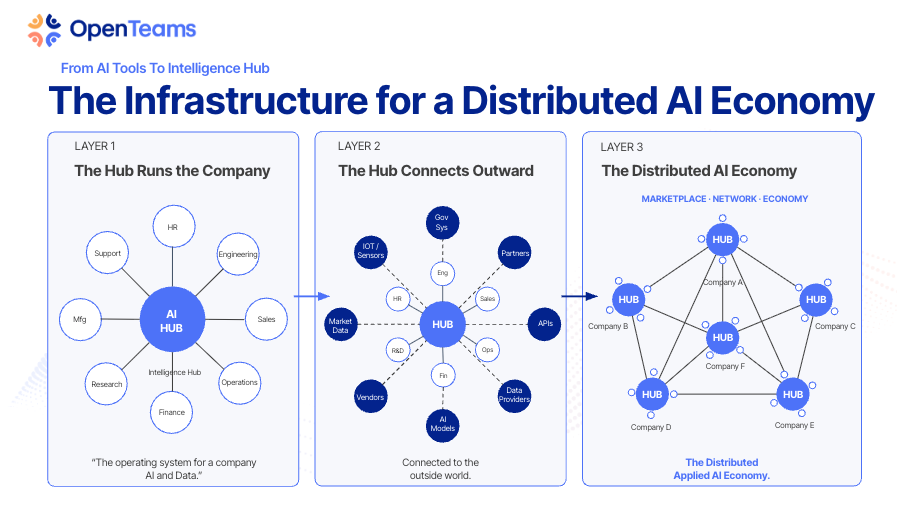
The progression he laid out:
Layer 1: The OS runs the company. Every department (HR, engineering, sales, operations, finance, research) connects to a central intelligence hub. Instead of 15 SaaS products with 15 logins and 15 siloed datasets, you have one operating system that holds the full context. Agents inside this OS can coordinate across functions because they see the whole picture.
Layer 2: The OS connects outward. It doesn't stay internal. It connects to vendors, partners, market data, government systems, AI models, APIs, data providers. Your company's intelligence system becomes a node in a larger network, exchanging value with the outside world on your terms.
Layer 3: The distributed AI economy. When many companies run sovereign business operating systems that can interoperate, you get a new kind of economy. Not a few hyperscalers controlling all the data, but a distributed network of companies trading intelligence, services, and capabilities through compatible, trust-based connections.
This isn't speculative. Companies are building this now. The question is whether yours will be one of them.
The All-In Dilemma
Here's the tension every leader hits when they understand this: AI is only as useful as the context it has access to. But giving AI access to everything requires an enormous act of trust.
You can't half-commit to a business OS. A system that holds your sales data but not your financial data can't give you strategic advice. A system that knows your product roadmap but not your team dynamics can't help you make hiring decisions. The value is in the completeness.
This creates a dilemma. To get the full value of AI for your organization, you need to go all-in: all your data, all your workflows, all your institutional knowledge, consolidated in one place. That's the only way the system compounds. Partial context produces partial intelligence.
But going all-in means the stakes are as high as they can possibly be. Which is why the next section matters more than any technical architecture.
Trust Is the Bottleneck
The bottleneck to the AI-powered future is not compute. It's not models. It's not tokens or context windows.
It's trust.
Three layers of trust determine whether a Sovereign Agentic Business OS succeeds or fails:
Trust the stack
The infrastructure your business OS runs on matters enormously. If your company's entire operational brain lives inside a platform whose business model depends on harvesting your data, you don't have sovereignty. You have a dependency.
Open-source stacks like Nebari (from OpenTeams) exist specifically to solve this: managed infrastructure you actually own. No vendor lock-in. No data leaving your control. Your business OS runs on your terms.
As Travis put it at AAL#3: the goal is coordination, not consolidation. You want an ecosystem of trusted tools that interoperate, not a single vendor that controls everything.
Trust the practitioner
Someone has to build your business OS. That person (or team) will touch everything: your financials, your client relationships, your strategic plans, your employee data, your competitive intelligence. They will have more context about your business than almost anyone in your organization.
This is why the applied AI practitioner role is so consequential. It's not just a technical job. It's a trust job. You're not hiring someone to set up a chatbot. You're entrusting someone with the operating system of your company's future.
The practitioners who thrive in this role are not just technically excellent. They understand security. They understand access control. They understand that a backdoor in a business OS isn't a bug: it's an existential risk. And they operate with the integrity that the role demands.
Trust the relationships
Vendor lock-in compounds. But so does trust.
When you work with a practitioner or a partner you trust, that relationship compounds over time. They learn your business. They anticipate your needs. They build systems that reflect your actual operations, not a generic template.
Travis made this point emphatically: "Relationship lock-in is what you want. Trust also compounds. Relationships also compound. If somebody trusts you and they'll still be buying from you if they trust you. That will still matter."
The companies that build the best business operating systems will be the ones that invest in trusted relationships with the people building them.
What This Means for Your Organization
If you're a business leader reading this, here's the practical reality:
The transition is happening now. Companies are already moving from scattered SaaS to sovereign business operating systems. Every month you wait, the gap between your operational capacity and your competitors' widens.
You don't need to build it all at once. Start with a Minimum Viable Jarvis: a personal AI operating system for the CEO or a key executive. Experience the power of consolidated context firsthand. Then expand to the team and organizational level.
The practitioner matters more than the tool. The difference between a business OS that transforms your company and one that becomes shelfware is the person (or team) who builds and maintains it. Find someone you trust. Invest in that relationship.
Sovereignty is not optional. If your business OS runs on infrastructure you don't control, you've traded one form of dependency for another. Own your data. Own your infrastructure. Own your future.
The Distributed Future
The endgame is not one company with one OS. It's millions of companies, each running sovereign agentic business operating systems, connected through trust-based relationships and compatible protocols. A distributed AI economy where intelligence flows between organizations without any single entity controlling the network.
This is the vision Applied AI Society is building toward. Not by selling a product, but by equipping practitioners, publishing open-source literacy material, and creating communities where the people building this future can find each other.
The Sovereign Agentic Business OS is not just a technical architecture. It's a statement about who owns the future of work, and a commitment to building that future in a way that respects the most precious resource any human has: their attention, their energy, and their time on this earth.
What's Here
- Principles: The foundational ideas behind sovereign agentic business operating systems. What sovereignty means, why it matters, and what to look for when evaluating your own setup.
- The Question Bank: The highest-leverage thing a business OS can do is ask you better questions than you'd ask yourself. A starter set of questions worth programming into yours.
Further Reading
- The Minimum Viable Jarvis: How to start with a personal AI operating system today
- Business OS Administrator: The emerging role responsible for maintaining organizational AI operating systems
- Truth Management: The discipline of documenting the knowledge that powers your business OS
- Context Engineering: The skill of curating the right information for AI systems
- The Writing on the Wall: Why the urgency is real and the window is closing